Brecht into the Metaverse
Artistic Research Across Various Media
2022 - today

About
Brecht into the Metaverse is a long term artistic research project on diversity, democracy and collaboration in social virtual worlds. At the centre of the project is the virtual world "Brecht into the Metaverse" in the massively multiplayer online game VRChat. The project evolved into four distinct formats: a television series (Dude, Where Is That Metaverse?), a dialogue-based VR installation (Virtual Weapons), a publication (Das Metaversum zerstalten) and an intervention (how to move public money (fast).

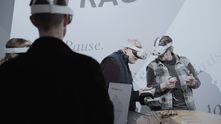
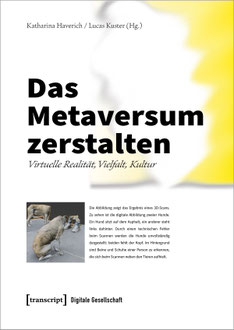

Virtual World Building Process
Who is designing Virtual Worlds a.k.a. the Metaverse and for whom are they made use? Will we continue to work with excluding designs, producing the -isms like racism, ageism and ableism that we have in the built environment?
The project understands the world-building process as a political and theatrical practice that opens up a broad vocabulary: transformation, encounter, learning, risk, presentation, and the exploration of new spaces.
The conceptual foundation is the play “Señora Carrar’s Rifles” by German playwright Bertolt Brecht, whose alienation effect and critical approach to emotional identification offer a productive framework for engaging with both the possibilities and limitations of immersive media.
The point of departure is the social VR platform VRChat, with its thousands of community-built worlds. The architecture of "Brecht into the Metaverse" is based on how open air museums work: as visitors move through reconstructed environments, they gain knowledge by observing, handling objects, and situating information within lived spatial contexts.
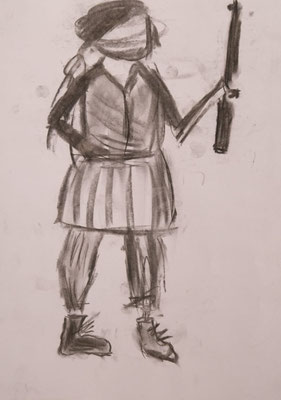
As part of the development process, we read the play aloud to the artists of the inclusive RambaZamba Theater Atelier, who responded by creating charcoal drawings inspired by the characters, atmospheres, and themes of the work. These drawings then became the artistic basis for the next stage of production: together with INVR.SPACE, they were transformed into three-dimensional avatars, objects, and spatial elements that define the virtual stage environment.
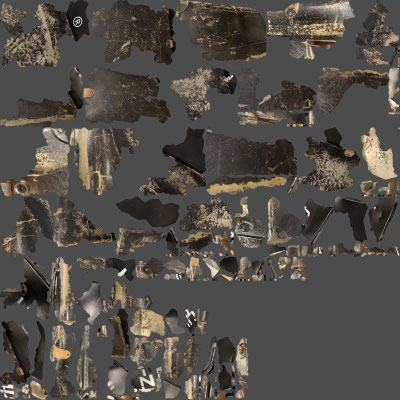
We also held a series of workshops with actors from the inclusive theatre company RambaZamba Theater, where we introduced them to the LiDAR scanning process and demonstrated how it works; together, they scanned selected objects from the theatre space, which were then integrated directly into the virtual world as 3D elements.
In addition to this, we issued an open call for 3D artists who have experienced discrimination or marginalisation, inviting them to contribute assets for the world, with the aim of creating a collaborative production process in which lived experience informs the design of objects, avatars, and environments used in the virtual stage.
Finally, we went Spain to visit some of the key locations in the context in which the play is set: the Spanish Civil War. We used 3D scanning techniques and placed those 3D objects into the virtual world.
The play “Señora Carrar’s Rifles” was translated into Simple German and Simple English and is displayed on interactive virtual tablets within the world, allowing both guests and performers to access the text directly and use it as a shared, accessible script for performing the play.
The Virtual World is being used as a film set and performance stage, it has been exhibited in different contexts and presented in wold tours as well as academic conferences.


Showings
Virtual Weapons (Brecht Fragments)
From Stage to State. The Role of Art in Shaping Democratic Spaces Conference
Kraków, Poland (2026)
TV Series Pilot "Dude, Where Is That Metaverse?"
Firmament GmbH, during Berlinale
Berlin, Germany (2026)
Virtual Weapons (Brecht Fragments)
PlayLab, Campfire Conference
Fragments #21 - #30
Skövde, Sweden (2025)
TV Series Pilot "Dude, Where Is That Metaverse?"
German House, SXSW
Austin, Texas U.S.A. (2025)
Virtual Weapons (Brecht Fragments)
Stary Browar, Embodied Realms Festival
Fragments #14 - #20
Poznań, Poland (2025)
Virtual Weapons (Brecht Fragments)
Kühlhaus, Berlin Art Week / EMIXAR II
Fragments #4 - #13
Berlin, Germany (2025)
Virtual Weapons (Brecht Fragments)
Berlin School of VR, during Berlinale
Fragments #1 - #3
Berlin, Germany (2025)
World-Building "Brecht into the Metaverse"
Silent Green, A Maze Festival
Berlin, Germany (2023)
Video Series "how to move public money (fast)"
Arena Berlin, re:publica
Berlin, Germany (2023)
World-Building "Brecht into the Metaverse"
Festival of Democracy
Berlin-Oberschöneweide, Germany (2023)
Exhibitions
Virtual World "Brecht into the Metaverse"
Special Exhibition "Metaverse. Phänomenal digital?"
Deutsches Museum Nürnberg
Nuremberg, Germany (2024)
Presentations
TV Series "Dude, Where Is That Metaverse"
Atelier Gardens, Good Media Lab / Doxumentale
Berlin, Germany (2025)
Virtual World "Brecht into the Metaverse" at
"Perpetual Beta", guided tour.
VRChat, Goethe Institute (2024)
Video Series "how to move public money (fast)"
re:publica
Hamburg, Germany (2023)
World-Building "Brecht into the Metaverse"
Zip Scene Conference,
Prague, Czech Republic (2023)
TV Series "Dude, Where Is That Metaverse"
Medienboard Berlin Brandenburg Delegation,
Venice Immersive, Venice International Film Festival
Venice, Italy (2023)
TV Series "Dude, Where Is That Metaverse"
Dok Exchange XR Showcase, Dok Leipzig
Online (2022)
Press / Discussion
Team Virtual World "Brecht into the Metaverse"
Katharina Haverich - Concept
Dr. Roman Miletitch - Technological Artist
Dr. Lucas Kuster - Art Direction
Dr. Roman Miletitch, Helen Lam, Zenker Zwonge, Daniel Boubet, INVR.SPACE: Sönke Kirchhof (Executive Producer), Jessica Zippel (Line Producer), Timo Heikkilä (Developer), Yume Tanaka (Developer / 3D Artist), Zacharoula Giarlou (3D Artist), Alexander Dietz (3D Artist), Niklar Schmidt (3D Artist) - VR Design / VR Creators
Rambazamba Atelier: Mario Peinze, Sabine Kaemmel, Thomas Zwerger - Co-Design Virtual World
Michael Hoppe - Sound
Lenn Blaschke - Research and Key-Concept Accessible Virtual Stage
Ymusic GmbH - Producer
Team TV Series "Dude, Where Is That Metaverse"
Katharina Haverich - Concept
Anna Loll, Matthias Zuber - Screenplay
Eric Nikodym (Ymusic), Katharina Haverich - Producers
Manuel Ruge, Jakob Gross, Katharina Haverich, Lenn Blaschke - Directors of Photograhy
Sophie Messerschmidt, Matthias Zuber - Editors
Konstantin Bez - Artistic Collaboration & Project Coordination
Jakob Gross - Sound Recording
Thomas Wallmann, Firmament - Sound Design
Dr. Lucas Kuster - Title Design, Visuality
Wiebke Wesselmann - Head of Production
Sonja Baltruschat - Diversity Manager
deaf_danielo_89, CODApop - VRChat Sign Language
Anne Leichtfuß - Translator Plain German
Emilia Arana Manzano - Location Scouting / Kids Casting, Spain
Selena Gomez - Set Assistance, Berlin
With:
Michael Baumeister, Konstantin Bez, Lioba Breitsprecher, Ahmet Çetinkaya, Katharina Haverich, Levi Haverich, Sadie Lune, Cayetana Arana Maiques, Jimena Arana Maiques, Valentina Muñoz Romero, Antonio J. Sánchez, Mateo González Sánchez, Zora Schemm, Mateo Villarroel Sintes, Nele Winkler, Michael Wittsack
Thank you:
Vincent Maurer, Enrique Torres & Team (re:publica 24)
Güney Aksünger (It's A Long Story)
Thomas Schaal (Tauchzentrale Kreuzberg)
Antonio J. Sánchez (Refugios de la Guerra Civil de Almería)
RambaZamba Theater Berlin
Via Blumenfisch Berlin
Escuale de Surf Awa, Motril
Berlin 61 Confitería y Restaurante (Motril)
Team Publication "Das Metaversum zerstalten"
Katharina Haverich and Dr. Lucas Kuster - Editors
Anika Krbetschek, Carolin Sibilak, David Hughes, Dirk Sorge, Fernanda Parente, Jens Fehrenbacher, Julia Bruton, Jocelyne Stahl, Katharina Haverich, Kent Bye, Marietta Kesting, Ranjit Menon, Rosa Di Nero, Sonja Baltruschat - Contibutors
Dr. Lucas Kuster - Cover Design
Dr. Roman Miletitch - Cover Image
Sonja Baltruschat, Katharina Haverich, Dr. Lucas Kuster, Babusi Nyoni, Dr. Inga Scharf Da Silva - Review Committee
Anne Leichtfuß - Translator Plain German
Prof. Dr. Stephan Otto, Dr. Ann Kristin Haverich - Proof Reading
Dr. Lucas Kuster - Concept and Design
Mario Peinze, Sabine Kaemmel, Thomas Zwerger, Eberhard Pastow (RambaZamber Atelier Berlin) - Visual Comments
Konstantin Bez - Coordination and Editorial Collaboration

Team "how to move public money (fast)"
Katharina Haverich - Concept & Video
Sophie Messerschmidt, Firmament - Editor
Konstantin Bez - Coordination and Artistic Collaboration
Michael Hoppe - Sound Installation
With:
W.W. (Artistic Producer - Cultural Sector)
S.B. (Consultant / Coach - Cultural Sector)
C.S. (Scientist, Founder, Project Manager - University)
M.W. (Programme Director - University)
K.W. (Programme Officer - Foundation)
E.N. (Cultural Manager / Managing Director)
J.G. (Public Sector employee)
A.W. (Festival Production Manager)
Y.R. (Author, Curator)
J.K. (Managing Director - Cultural Sector)
I.S.D.S. (Scientist, Artist)
H.H. (Coder - Cultural Sector)
Team Diorama of Virtual World
Katharina Haverich - Concept
Franz Thöricht - Design & Building
Christopher Böhm - 3D Print
Michael Baumann -Testing
All projects produced by Ymusic GmbH
Funded by

